GN Separation has recently completed the production and shipment of an integrated sludge dewatering package for an overseas customer. The system combines a GNDL302 Screw Press Sludge Dewatering Machine with a GNSJY2000 Automatic Chemical Dosing Unit, providing a reliable and energy-efficient solution for continuous sludge treatment.
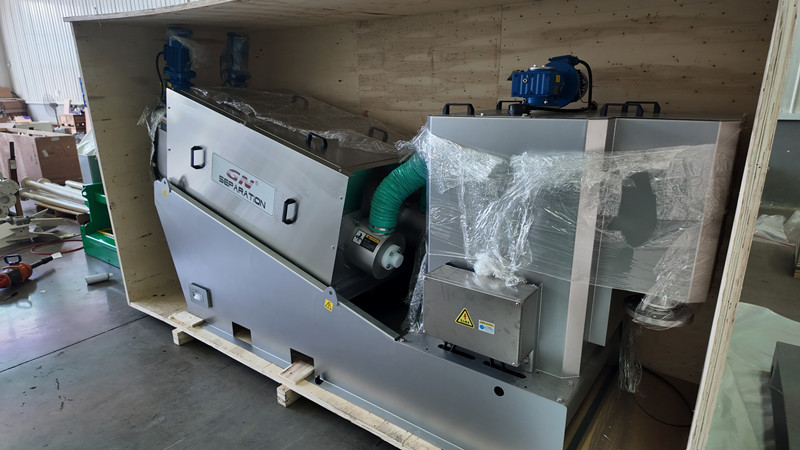
The package is designed to optimize sludge conditioning and mechanical dewatering while reducing operating costs and simplifying plant operation. Its compact skid-mounted design also makes installation and commissioning more convenient for end users.
Complete Sludge Dewatering Process
Efficient sludge dewatering depends not only on the dewatering machine itself but also on proper chemical conditioning. In this package, the polymer dosing unit and screw press work together to achieve stable dewatering performance.
The treatment process includes:
- Automatic preparation of polymer solution
- Precise polymer dosing and sludge flocculation
- Continuous sludge dewatering using the screw press
- Collection of dewatered sludge cake
- Return of filtrate to the wastewater treatment system
This integrated process improves sludge dewatering efficiency while reducing polymer consumption and labor requirements.
GNDL302 Screw Press for Continuous Dewatering
The GNDL302 screw press is designed for continuous sludge thickening and dewatering. Its low-speed screw conveyor works together with fixed and moving rings to gradually increase pressure inside the dewatering zone, allowing water to pass through the filter gaps while conveying the sludge cake toward the discharge outlet.
Compared with conventional dewatering equipment, the screw press offers several advantages:
- Low power consumption
- Continuous automatic operation
- Self-cleaning mechanism to reduce clogging
- Low noise and vibration
- Simple maintenance requirements
- Long equipment service life
The equipment is suitable for municipal wastewater as well as various industrial sludge applications.
Automatic Polymer Preparation
The GNSJY2000 Chemical Dosing Unit automatically prepares polymer solution with accurate concentration control and continuous output. Proper flocculation enhances sludge particle aggregation before entering the screw press, contributing to improved cake dryness and more stable operation.
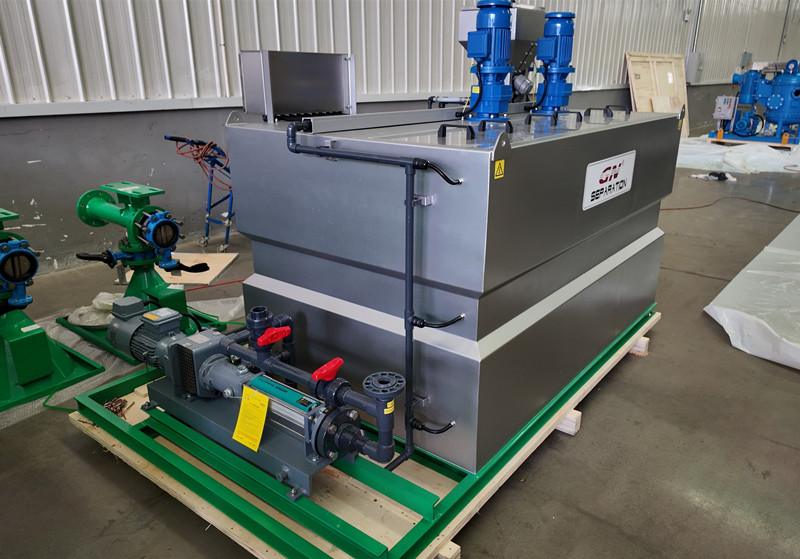
The automatic system also minimizes manual chemical preparation, improves dosing consistency, and helps reduce operating costs.
Supporting Various Industrial Applications
GN Separation provides screw press sludge dewatering systems for a wide range of industries, including municipal wastewater treatment, food and beverage processing, paper manufacturing, chemical plants, textile production, and other industrial wastewater treatment facilities.
Each sludge dewatering package can be configured according to sludge characteristics, treatment capacity, and project requirements. By combining reliable equipment with practical engineering experience, GN Separation continues to deliver customized solid-liquid separation solutions for customers around the world.