Decanter centrifuges contain numerous gears, and if any one of them encounters an issue, it can affect the entire operation. Based on the experience of decanter centrifuge manufacturers, common faults in centrifuge gears can generally be summarized as follows.
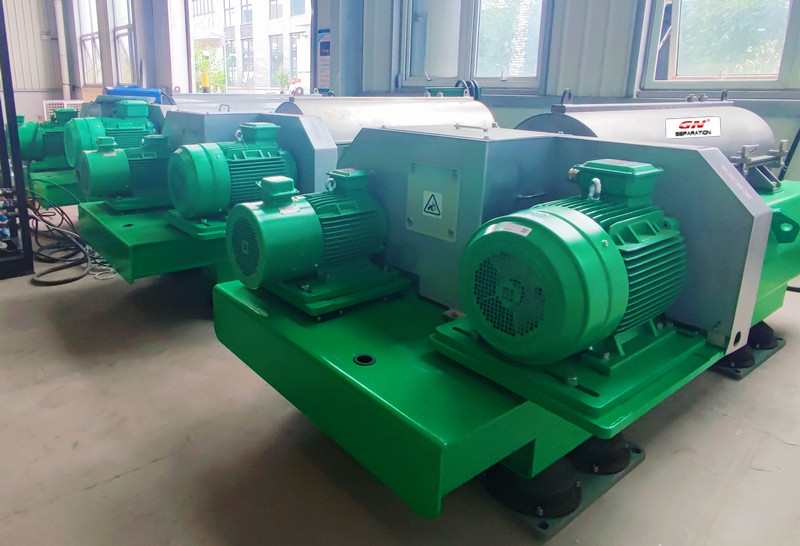
Common gear faults in decanter centrifuges include tooth surface wear, gluing and scratching on the tooth surface, tooth surface contact fatigue, bending fatigue, and broken teeth. Causes of these issues include manufacturing defects, improper assembly, inadequate lubrication, overload, and operational errors. Due to the structure and operating principles of gears, their vibration signals are often complex. Diagnosing gear vibration issues requires analysis in both the time domain and frequency domain. Whether the gear is in a normal or abnormal state, the change frequency of the gear meshing stiffness will always be present. Therefore, diagnosis should focus on the gear meshing frequency component. Due to the complex nature of gear signals, faults significantly impact the vibration signal. Amplitude modulation and frequency modulation can lead to numerous sideband structures in the gear vibration spectrum, which necessitates a detailed analysis during fault diagnosis.
The characteristic fault frequencies of centrifuge gears are as follows:
- Normal Frequency Spectrum: The spectrum typically shows the 1X frequency and meshing frequencies of all rotating shafts. Speed sidebands appear on both sides of the gear meshing frequency, with small peak values.
- Gear Wear: The gear’s natural frequency may appear, with a sideband at the rotational speed of the shaft containing the worn gear. With significant wear, a sideband with a higher peak may emerge near the meshing frequency.
- Eccentric Gears: Sidebands with higher amplitudes near the meshing frequency indicate gear eccentricity or shaft misalignment. As the load increases, so does the peak at the meshing frequency.
- Misalignment of Gears: This issue typically excites vibrations at the second or higher harmonics of the meshing frequency. Peaks at the 2X or 3X meshing frequency spectrum may increase, with side frequencies separated by the rotational speed.