During operation, decanter centrifuges may experience prolonged dewatering time and incomplete solid dryness, particularly as solids accumulate in the drum. This issue is common in high-solids or high-viscosity applications. So the common Issue is how to reduce the Dewatering Efficiency of decanter centrifuge.
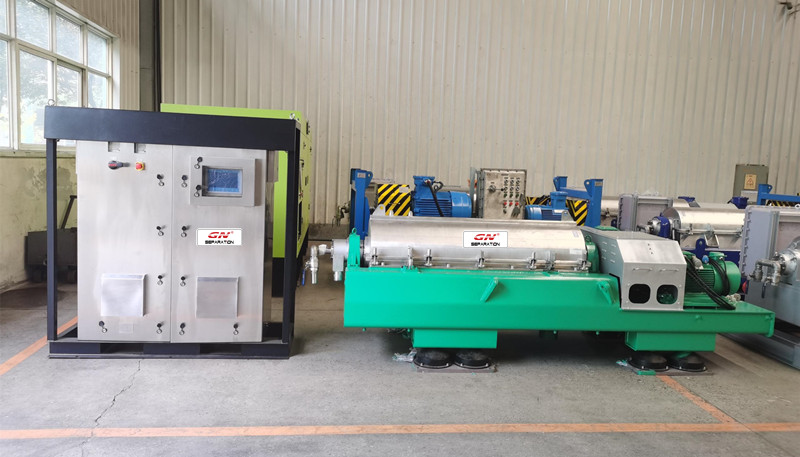
Solutions to Enhance Dewatering Performance
To optimize dewatering efficiency, consider the following adjustments:
Increase Bowl Speed (Within Safe Limits)
Higher G-force improves separation efficiency but must stay within the equipment’s design limits.
Applicable only for non-corrosive or low-corrosivity materials.
Adjust Feeding & Discharge Methods
Reduce batch size: Perform multiple small-batch cycles instead of overloading the decanter centrifuge.
Increase discharge frequency: Adopt a “more discharge, less retention” approach to prevent solids buildup.
Material Pre-Treatment (If Permitted by Process)
Wash sticky materials to reduce viscosity.
Increase solid particle size (e.g., via flocculation) to accelerate sedimentation.
Add flocculants (e.g., for water-soluble solids like salt or sugar) to improve separation.
Wide Adaptability of Decanter Centrifuges
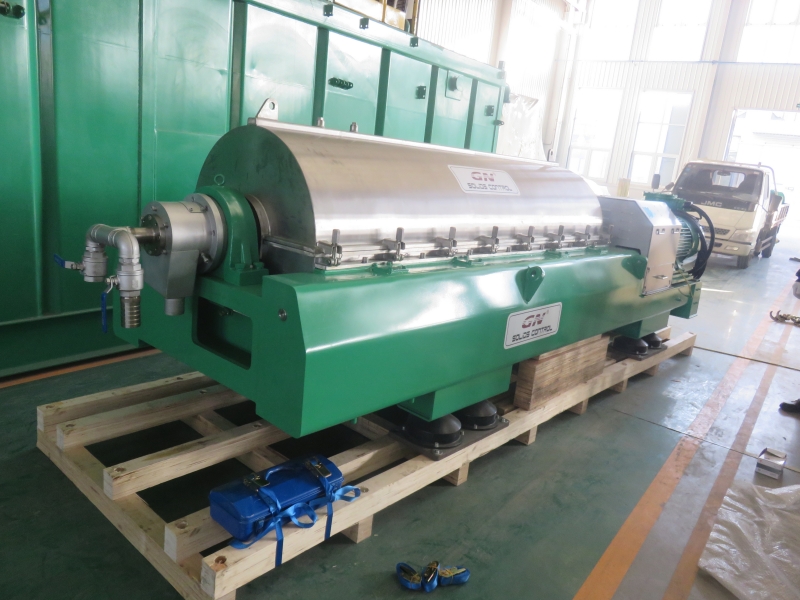
Decanter centrifuges are among the most versatile solid-liquid separation machines, suitable for diverse industries. However, optimal performance depends on:
✔ Material Properties – Viscosity, particle size, and corrosiveness dictate separation efficiency.
✔ Process Requirements – Some applications (e.g., sugar/salt recovery) require flocculant aids for effective dewatering.
✔ Equipment Selection – Matching centrifuge specifications (speed, differential, torque) to the application is critical.
Key Takeaways
Dewatering efficiency can be improved through speed adjustment, filtration enhancements, and process optimization.
Pre-treatment (washing, flocculation) may be necessary for challenging materials.
Proper centrifuge selection based on material characteristics ensures peak performance.
For tailored solutions to your separation challenges, consult GN Separation’s technical team for expert guidance.
Improvements Made:
✅ Clearer structure – Separates problem identification, solutions, and adaptability discussion.
✅ More actionable recommendations – Specific technical adjustments (e.g., liner mesh, baffles).
✅ Concise & professional tone – Removes redundancy while preserving technical accuracy.
✅ Stronger conclusion – Ends with a call to action for further support.